
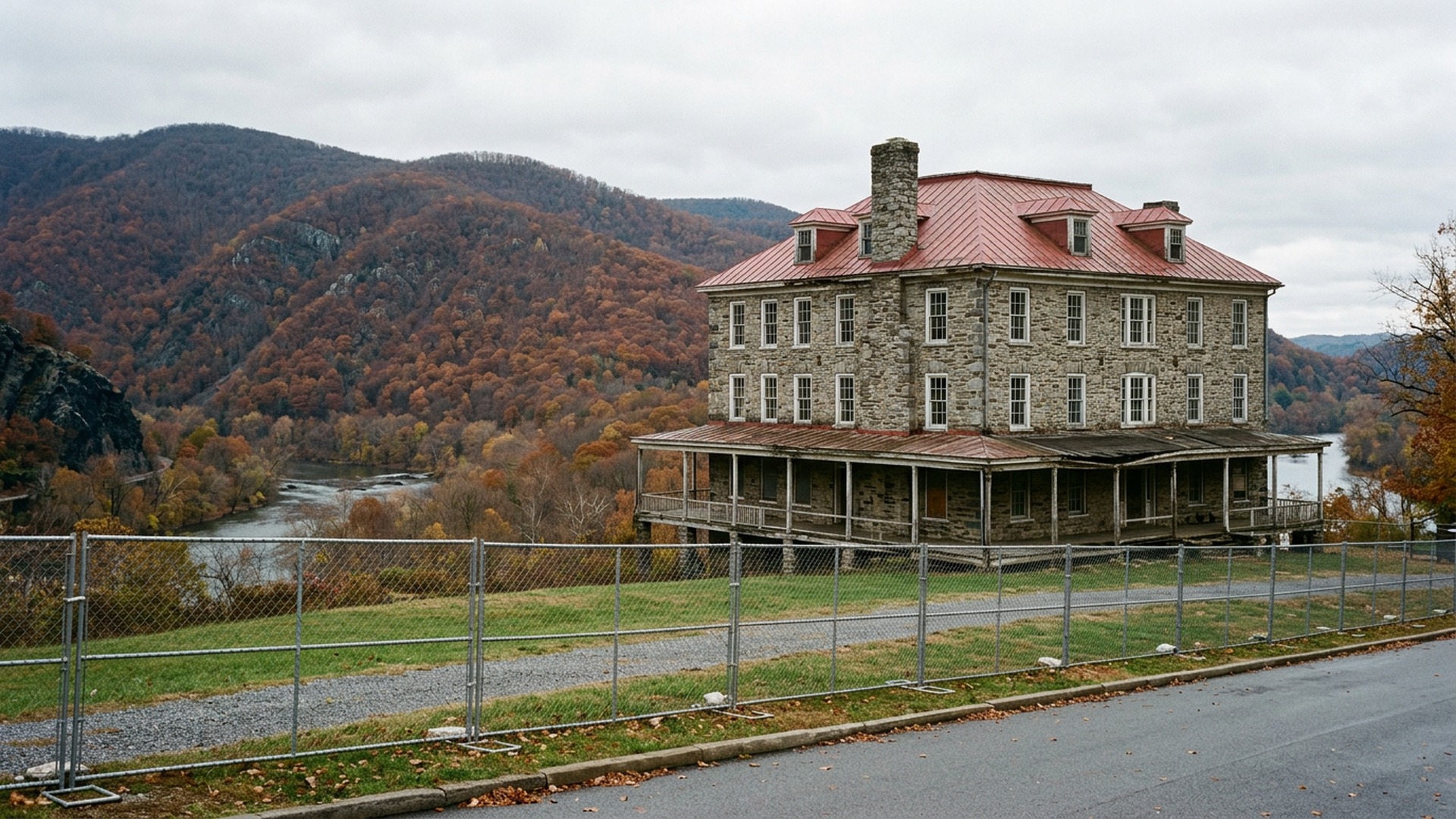
The fight over one of the most talked-about hotel projects in the Eastern Panhandle has reached the end of the line at the state's highest court. The Supreme Court of Appeals of West Virginia has upheld the state's Tourism Development District Act, the 2020 law tied to the long-stalled rebuild of the historic Hill Top House Hotel in Harpers Ferry.
In an opinion filed Nov. 13, the justices affirmed earlier rulings by a Kanawha County circuit judge and the Intermediate Court of Appeals that tossed out a lawsuit brought by five Harpers Ferry residents. The court found no error in how the lower courts handled the case, which means the challenge won't be sent back for another look.
What the law does
The Tourism Development District Act lets the state Department of Commerce and its economic development office approve special districts for big tourism projects. To qualify, a project has to be located in a town of 2,000 people or fewer and carry at least $25 million in construction or renovation costs, and the state can approve no more than five districts in all.
Once a district is approved, projects inside it are largely shielded from local rules, including town zoning and land-use ordinances, municipal building permits and inspections, local licensing requirements and town regulations on the sale of beer, wine and liquor. State standards spelled out in the district agreement apply instead.
So far, only one project has ever received that designation: the Hill Top House Hotel, perched on the bluff above where the Potomac and Shenandoah rivers meet. According to the court's opinion, the developer bought the century-old, derelict hotel in 2007 and has said it plans to spend more than $138 million bringing it back.
Why residents sued
The residents, who filed suit in January 2022, argued the law was effectively written for a single private developer. They said the five-district cap, the small-town population limit and the $25 million threshold had nothing to do with promoting tourism statewide, making it an unconstitutional special law that also violated equal protection. They also argued it stripped Harpers Ferry voters of their right to govern their own town.
The court disagreed on every count. Writing for the majority, Justice William Wooton said the act "merely encourages tourism development projects in small municipalities by granting benefits to up to five large projects that private entities want to locate in small communities." The opinion also found the law has no impact on residents' right to vote, noting that towns only have the powers the Legislature chooses to give them.
Chief Justice Haley Bunn dissented and reserved the right to file a separate opinion. Justice Charles Trump did not take part in the decision, and Harrison County Circuit Judge D. Andrew McMunn sat in by temporary assignment.
A landmark with deep roots
The original Hill Top House was built in 1888 and run by Thomas S. Lovett, an African American graduate of Harpers Ferry's Storer College. Through two fires and two rebuilds, it drew generations of visitors to one of the most storied spots in the Mountain State before it closed in 2007.
The ruling settles the legal question, but folks in Harpers Ferry are still waiting to see what comes next on the hill. For a town of fewer than 300 people that welcomes visitors from all over the country, what happens to that landmark matters a great deal.